

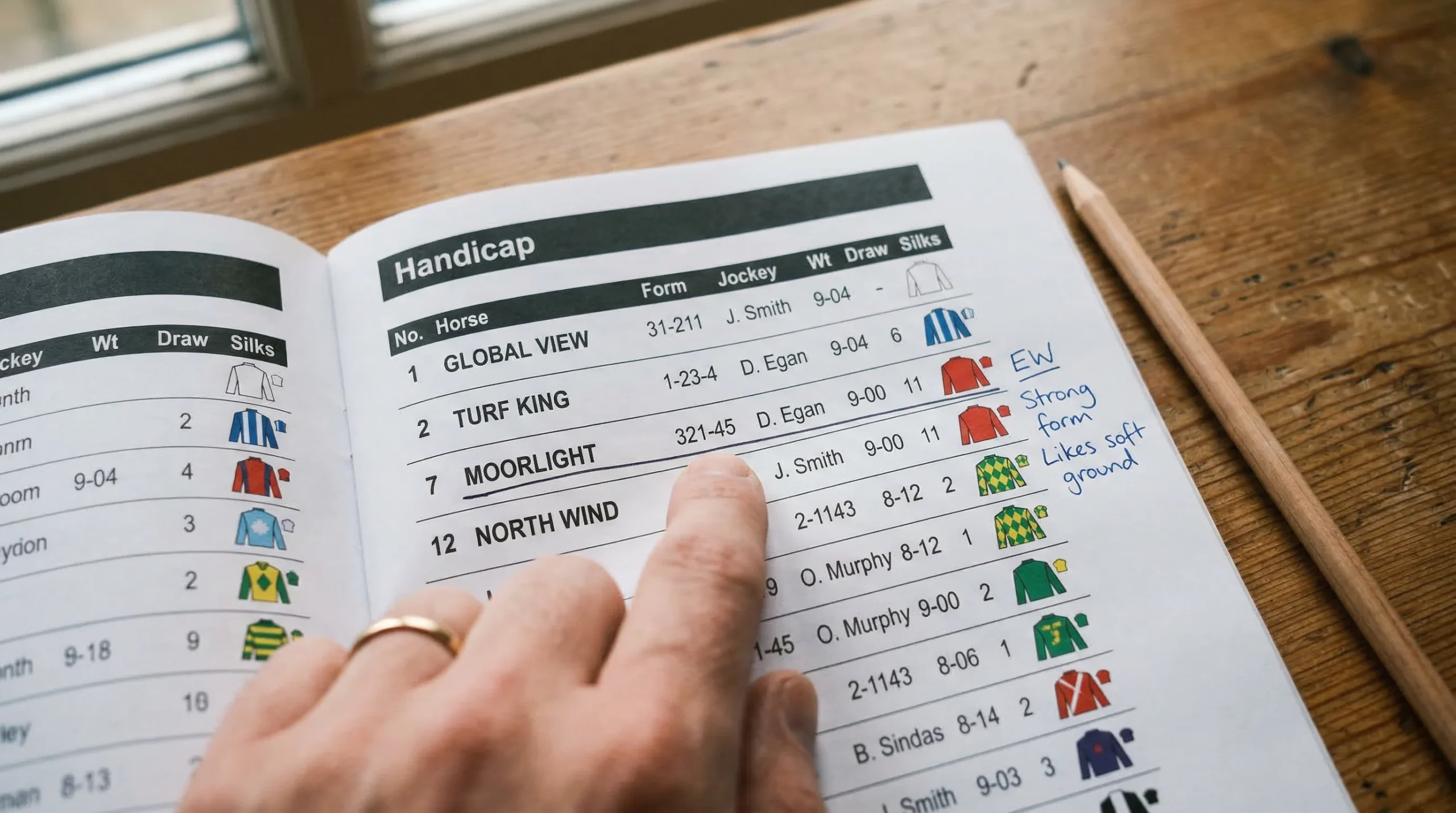
A Lincoln Handicap racecard is dense with information, most of it compressed into shorthand that baffles newcomers and occasionally catches out experienced punters who skim rather than read. The form figures, symbols, and abbreviations encode each horse’s racing history, but only for those who know the language. A glance at a string like “13-2411” tells a story, if you understand how to parse it.
This matters particularly for the Lincoln because the race attracts fields of twenty or more runners, each with form stretching back months or years. Scanning that volume of data quickly and accurately separates thorough analysis from guesswork. You cannot study every horse in depth — time does not permit it — so efficient racecard reading filters the field to a manageable shortlist.
The Lincoln’s status as the first major turf handicap adds complexity. Form figures often reference all-weather runs from winter or turf runs from the previous autumn, mixing surfaces and seasons in ways that require context beyond the raw numbers. Knowing what each symbol means is only the first step; interpreting relevance is where skill enters.
Racecard Layout
Racecards follow a standard structure, though presentation varies between newspapers, websites, and racecourse programmes. The core information includes the horse’s name, age, weight carried, trainer, jockey, owner, and form figures. Alongside these, you find the draw position — critical in the Lincoln — and often the official rating, recent finishing positions, and equipment notes.
Horses are listed by saddlecloth number, assigned based on their weight allocation. Lower numbers carry more weight; higher numbers carry less. In handicaps like the Lincoln, the top weight occupies number one, descending through the field. This numbering system helps identify where a horse sits in the handicap structure without memorising individual weights.
The draw number appears separately from the saddlecloth and indicates the starting stall position. In the Lincoln, with fields often exceeding twenty, draws range from single figures to the high teens or twenties. A horse might carry saddlecloth 5 but be drawn in stall 18, meaning it carries relatively high weight but starts toward the stands side of the track. These two numbers — saddlecloth and draw — frequently confuse punters who conflate them.
Official ratings, where listed, provide the handicapper’s assessment of each horse’s ability. Lincoln winners typically fall within the 94 to 102 range, with eight of the last ten winners since 2014 rated between 99 and 102. A horse rated outside this band is not eliminated, but the data suggests the handicapper’s assessment clusters winning types in that narrow corridor.
Weight is displayed in stones and pounds, following British convention. A horse carrying 9st 2lbs bears the equivalent of roughly 58 kilograms over the mile distance. Nine of the last eleven winners carried weights between 8st 12lbs and 9st 4lbs — another trend worth noting when scanning the racecard.
Form Figures Explained
Form figures display a horse’s recent finishing positions, reading left to right from oldest to most recent. A figure of 1 means the horse won; 2 means second place; 0 indicates a finish outside the first nine. The hyphen separates different seasons, so “142-312” shows three runs from a previous season followed by three from the current campaign.
Letters encode specific outcomes that numbers cannot capture. F denotes a fall — relevant in jump racing but extremely rare on the flat. U means unseated rider, usually through a starting stall incident or early-race mishap. P indicates pulled up, where the jockey stopped riding due to horse distress or injury. R shows a refusal, again more common over jumps. B means brought down by another horse’s fall. S signals slipped up, typically on wet ground.
For the Lincoln, the most important letter is the forward slash (/) that separates seasons older than the current and previous ones. A form line like “11/212-3” shows wins two seasons ago, placings last season, and a third place most recently. This layered history helps identify horses with established ability who may have lost form temporarily or are returning from absence.
Distances between finishers sometimes appear alongside figures, expressed in lengths. A notation like “1½” after a finishing position indicates the margin to the horse ahead. In handicaps, where weights theoretically equalise ability, small margins suggest closely matched fields and may point toward horses unlucky not to finish closer.
Course and distance form attracts asterisks or specific markers in many publications. A “C” might indicate the horse has won at the course before; “D” signals a win at the distance; “CD” combines both. For the Lincoln, prior Doncaster form and prior mile form both carry weight, though they predict future performance imperfectly — conditions vary, and the Lincoln’s unique characteristics make direct form translation unreliable.
Reading form figures quickly requires practice. The eye learns to spot winning figures, identify consistency through repeated placings, and flag concerns through strings of high numbers or absent seasons marked by long breaks. A horse showing “1112-0” suggests ability followed by a disappointing recent run — potentially a problem, or potentially an opportunity if the run has an explanation.
Symbols and Abbreviations
Beyond form figures, racecards deploy symbols and abbreviations for equipment, status, and conditions. Understanding these prevents overlooking factors that influence performance.
Headgear symbols indicate equipment changes. “b” denotes blinkers, which restrict peripheral vision and focus attention forward — sometimes helping horses who race lazily or are distracted by crowds. “v” signals a visor, a milder version with partial visibility. “t” indicates a tongue tie, securing the tongue to prevent breathing obstruction. “h” shows a hood, worn pre-race to keep horses calm before going into the stalls. “e/s” or “e” marks first-time equipment, a significant factor since horses often improve dramatically when headgear is applied initially.
Going preferences appear through abbreviations or icons in some publications. “g” or “G” indicates the horse has won on good ground; “s” or “S” for soft; “f” or “F” for firm; “h” or “H” for heavy. Cross-referencing these with forecast conditions helps identify horses suited to the likely surface.
Trainer and jockey statistics sometimes accompany names — strike rates, course form, or recent winners. These provide quick context but can mislead if samples are small. A jockey with two wins from three Doncaster rides looks impressive until you note those three rides span five years.
Weight changes from last run — sometimes shown as “+” or “−” values — indicate handicap adjustments. A horse raised 5lbs after a win faces a stiffer task; one dropped 3lbs after a below-par run may be better handicapped. The Lincoln attracts horses whose trainers believe the handicapper has not caught up to improvement, making these adjustments particularly relevant.
Practical Application
Applying racecard literacy to the Lincoln means working systematically. Start by filtering on draw — horses drawn very low in large fields face statistical disadvantages on Doncaster’s straight mile. Then check weights against the historical trend favouring mid-range handicappers. Eliminate horses outside the typical winning profile unless compelling form suggests an exception.
Next, scan form figures for consistency. Horses showing repeated high numbers or long absences require positive explanations — a trainer change, equipment addition, or seasonal preference that justifies optimism. Those with solid recent figures who dropped in handicap after an unlucky run warrant closer attention; the market often undervalues explained failures.
Equipment changes on the day of the Lincoln deserve particular scrutiny. First-time blinkers or visors occasionally transform moderate handicappers into winners, and connections rarely apply new equipment without reason. A stable rolling out headgear in a competitive handicap usually believes in the horse’s chance.
Finally, cross-reference going preferences with the forecast conditions. A horse whose form figures show repeated wins on soft ground gains value if rain is expected; one with exclusively good-ground form loses appeal if the track rides testing. The racecard provides the data; weather forecasts provide the context.
Racecard reading is mechanical until it becomes instinctive. The Lincoln’s large fields reward those who process information efficiently, spotting patterns and anomalies that less diligent punters miss. Master the symbols, interpret the figures, and the racecard becomes a competitive advantage.
