
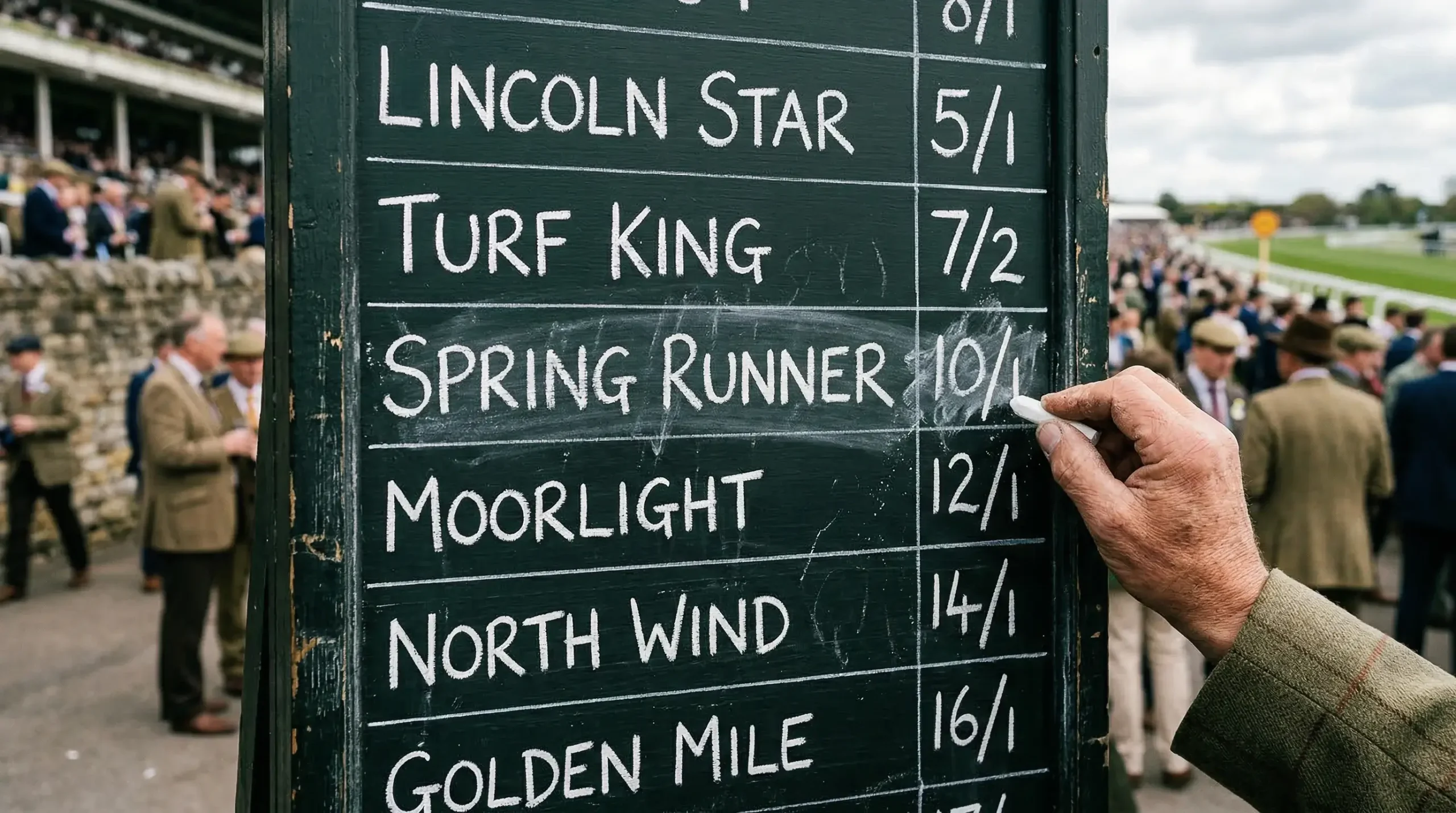
The Lincoln Handicap presents punters with a particular challenge: a field of twenty or more runners, each carrying different weights, all breaking from stalls on a straight mile where positioning matters. Finding value in such a competitive race requires more than picking a horse. It demands understanding how odds are constructed, where the bookmakers take their margin, and how prices differ across operators.
Odds comparison has become essential practice for serious punters. The difference between 14/1 and 16/1 on the same horse translates directly into profit over time. In a race where seven of the last eleven winners started at 12/1 or higher, those extra points matter. UK online betting generates approximately £5.4 billion in annual turnover, and bookmakers compete aggressively for this business by offering varying prices on the same selections.
This guide examines how odds function in big-field handicaps, what drives price variations between bookmakers, and how punters can systematically identify the best available prices for their Lincoln selections.
How Odds Work in Big-Field Handicaps
Bookmakers set odds to reflect their assessment of each horse’s winning probability while building in a profit margin. In a perfectly fair market, the implied probabilities of all runners would sum to exactly 100%. In reality, they sum to more than 100%, with the excess representing the bookmaker’s over-round or margin. Understanding this concept is fundamental to identifying value.
Analysis of Lincoln Handicap markets reveals over-round figures ranging from 117% in the most competitive years to 140% when bookmakers perceive heightened risk. The 2025 Lincoln saw an over-round of 140%, the highest in twenty years, suggesting bookmakers were uncertain about the outcome and built in extra protection. By contrast, the 2014 renewal had an over-round of just 117%, indicating a more confident market with tighter margins. This data, compiled by OLBG, demonstrates the significant variance in bookmaker confidence from year to year.
The over-round is not distributed evenly across all runners. Bookmakers typically take a larger margin on favourites, where the betting volume concentrates, and offer marginally better value on outsiders where liability is lower. This structural feature of the market means that backing shorter-priced horses in handicaps often carries worse value than backing longer-priced alternatives, all else being equal.
In a twenty-runner field, the mathematics become complex. Each bookmaker prices the race differently, weighting their assessment of individual horses based on trading patterns, available information, and competitive positioning. The result is price variation across the market, sometimes significant, creating opportunities for punters who take the time to compare.
Current Market Overview
The Lincoln Handicap market opens months before race day, with ante-post betting available from late autumn. Early prices tend to be wider as bookmakers lack information about which horses will be targeted at the race and what their final handicap marks will be. As the race approaches and entries are confirmed, the market tightens and price differentials narrow.
Ante-post markets typically see a clutch of horses at single-figure prices, with the bulk of the field priced between 12/1 and 33/1. The spread reflects genuine uncertainty about which horse will prevail, and history suggests the market’s collective wisdom is imperfect. Only one of the last eleven favourites has won, indicating that the shortest prices are not necessarily the best value.
Major bookmakers often price similar horses differently based on their trading positions. One firm might have taken significant bets on a particular horse and shortened its price to manage liability, while a competitor with less exposure maintains a longer price. These discrepancies create value for punters who compare systematically rather than accepting the first price they see.
The market becomes most liquid in the days immediately before the race, when final declarations are known and the full field is confirmed. This is when price competition intensifies, though it is also when the sharpest information has already been absorbed into the market. The trade-off between liquidity and value is something every punter must navigate based on their own circumstances and risk tolerance.
Exchange betting offers an alternative to traditional bookmaker odds. Betting exchanges allow punters to bet against each other rather than against the house, typically resulting in better odds but requiring the opposing side of the bet to be matched. For the Lincoln, exchange markets develop depth closer to the race and can offer superior prices, particularly for less fancied runners where bookmaker margins are highest.
Finding Best Prices: Practical Tips
Odds comparison websites provide a starting point for identifying the best available prices. These aggregators pull odds from multiple bookmakers in real time, displaying them side by side for easy comparison. For a race like the Lincoln with many runners and wide price variation, spending a few minutes comparing can add meaningful value to any bet.
Best Odds Guaranteed promotions, offered by most major bookmakers, protect punters who bet before the start against missing out on bigger prices. If you take 16/1 and the starting price drifts to 20/1, you receive the higher odds. This feature reduces the disadvantage of betting early, though it only applies to starting prices and not to other bookmakers’ prices at the off.
Price variation tends to be larger on outsiders than on favourites. A horse priced at 6/1 with one bookmaker might be 13/2 elsewhere, a difference of about 8%. The same horse at 25/1 might be 33/1 with a competitor, a difference of over 30% in potential returns. For punters who favour longer-priced selections in handicaps, systematic comparison pays dividends.
Multiple accounts across different bookmakers enable punters to access the best available price on each selection. While account restrictions can affect prolific winners, recreational punters generally find that maintaining several active accounts provides flexibility and value. The effort required to open accounts is a one-time cost that pays off across numerous bets over time.
Timing affects available prices. Early morning odds on race day often differ from those available closer to the off, as trading activity and market information reshape the landscape. There is no single optimal time to bet, but punters should be aware that prices move and the best approach depends on individual circumstances and the nature of the selection.
Odds Movement Patterns
Lincoln Handicap odds exhibit characteristic patterns as race day approaches. Ante-post prices are typically wider to compensate for non-runner risk, then contract once entries are confirmed. A horse at 25/1 in February might trade at 16/1 by March if it remains on track for the race, or drift out if connections suggest alternative targets.
Significant market moves often reflect information from stables about a horse’s wellbeing or fitness. A horse that works impressively on the gallops might shorten from 20/1 to 12/1 as reports filter through to the betting public. Conversely, horses reported to be below par may drift in the market. These moves represent the market processing new information and repricing accordingly.
The handicapper’s final assessment can trigger substantial price changes. If a horse is raised in the weights after a late-season victory, it might drift as punters reassess its chances under the new burden. Equally, a horse that squeaks into the race with a lower weight than expected might shorten sharply. The interplay between weights and odds is particularly pronounced in competitive handicaps.
Race-day moves carry different information content than ante-post fluctuations. Sharp money arriving close to the off often indicates confident support from connections or significant punters who believe they hold an edge. Following these moves blindly is rarely profitable, but tracking them provides insight into market sentiment and where significant sums are being wagered.
History shows that Lincoln winners come from across the price spectrum. While market moves attract attention, some winners barely feature in pre-race discussion. Godwinson won the 2025 renewal at 15/2, a price that suggests competitive but not overwhelming support. The lesson is that price movement tells a story but not necessarily the whole story.
Finding value in the Lincoln Handicap market requires systematic comparison and an understanding of how bookmakers construct their prices. The race’s competitive nature and wide-open markets create genuine opportunities for punters willing to shop around. In a sport where margins matter, taking the best available price on every bet compounds into meaningful advantage over time.