

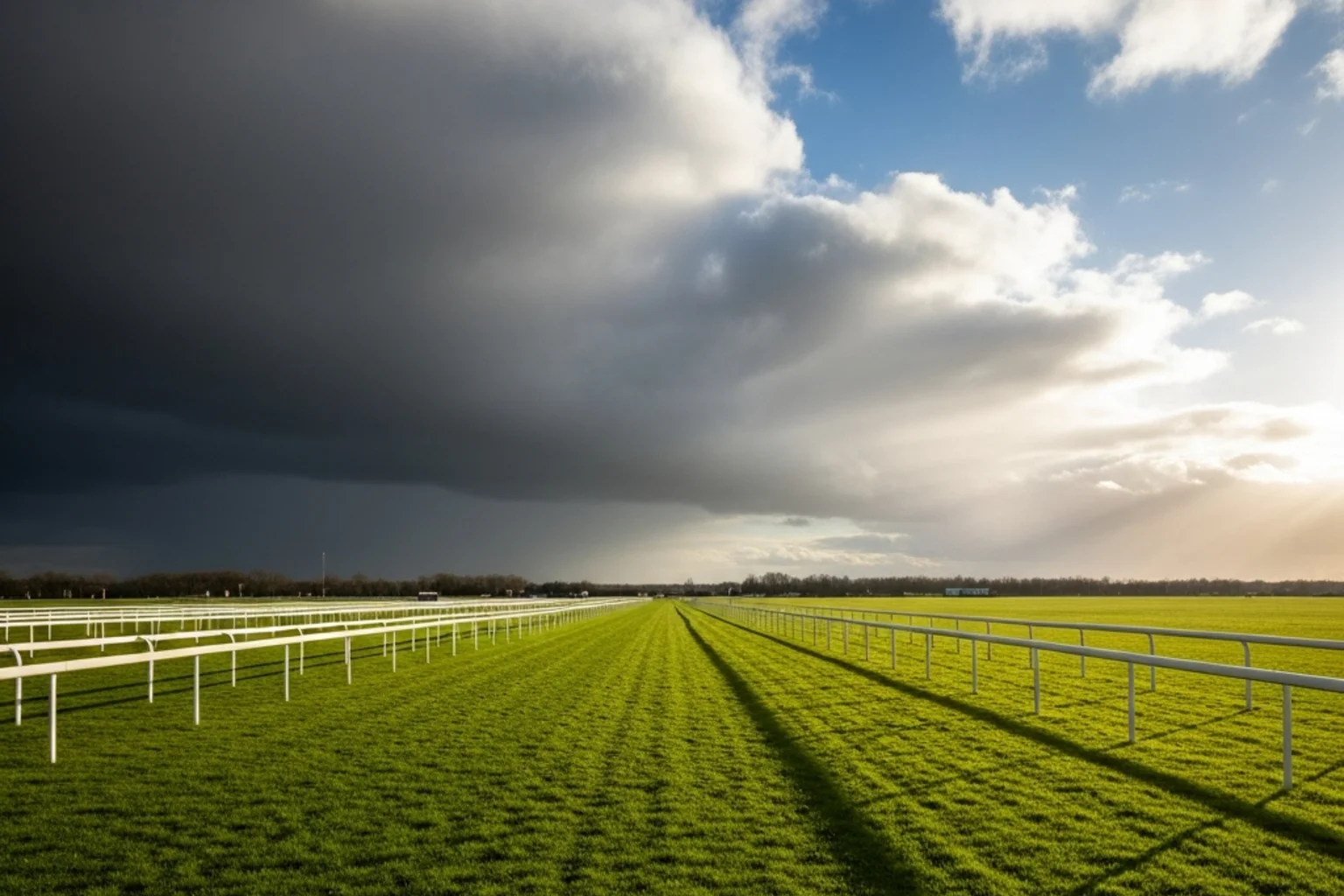
March in South Yorkshire is not a month that makes meteorological promises. The Lincoln Handicap falls at the awkward junction of winter’s retreat and spring’s reluctant arrival, when Doncaster’s straight mile can shift from firm to heavy within a single week. This unpredictability is not a bug in the race’s scheduling — it is the defining feature that separates astute bettors from those who treat the going as an afterthought.
Weather matters in the Lincoln more than in most handicaps because the race arrives before form has been tested under consistent conditions. Horses return from winter breaks, some having seen only all-weather surfaces since October, and suddenly face turf that may be waterlogged, tacky, or drying out by the hour. A five-furlong breeze on the gallops tells you nothing about how a horse handles soft going on a straight mile with a headwind pushing against the field.
Understanding how Doncaster’s weather translates into going — and how going dictates pace, draw bias, and ultimately results — gives you information most casual punters overlook. The forecast becomes a betting tool rather than small talk.
Spring Weather at Doncaster
Doncaster sits on the River Don floodplain in South Yorkshire, which tells you most of what you need to know about its drainage challenges. The Town Moor racecourse is relatively flat, and the straight mile that hosts the Lincoln runs across clay-based soil that retains moisture longer than the chalkier downs of Newmarket or the sandy loam at Goodwood. When March brings persistent rain — which it frequently does — the water has nowhere obvious to go.
Late March temperatures in the region typically hover between 5°C and 12°C, rarely warm enough to bake moisture out of the ground quickly. A sunny race day means little if the preceding week delivered 30mm of rain. Conversely, an overcast morning following two dry weeks might produce going that rides faster than it looks. The visual assessment of the turf deceives more punters than any other variable in this race.
Wind direction compounds the complexity. Easterly winds off the North Sea carry moisture and chill; westerly flows from the Pennines tend to be milder but can bring frontal rain systems that dump significant precipitation. The Lincoln frequently coincides with Atlantic low-pressure systems tracking across northern England, turning race week forecasts into daily revisions. Groundstaff update the official going multiple times before the off, and those updates move markets.
The race has seen every conceivable ground condition over its Doncaster tenure since 1965. Heavy, soft, good to soft, good, good to firm — all have featured, sometimes within the same decade. This variability means no horse can be dismissed on going grounds alone, but it also means horses with proven form on the prevailing surface hold a measurable edge.
How Weather Affects Going
The relationship between weather and going is not linear. Twenty millimetres of rain falling over two days produces different ground than the same volume compressed into four hours. Steady drizzle saturates evenly; a downpour overwhelms drainage and creates uneven patches where standing water lingers in subtle depressions. The Lincoln’s straight mile, being flat, suffers from pooling more than undulating tracks.
Temperature matters as much as precipitation. Cold nights following rain prevent evaporation; frost can create a deceptive surface that appears firm but sits atop soggy substrate. Horses break through the crust and labour in conditions that looked innocuous at declaration stage. Warm, breezy conditions accelerate drying, and a track that walked soft on Friday morning might ride good by Saturday’s first race. Shrewd trainers monitor forecasts obsessively in race week, adjusting equipment and sometimes withdrawing horses if conditions turn against their charge’s preferences.
Doncaster’s groundstaff are experienced at managing the straight course, but they cannot work miracles. Covers protect specific areas, and selective watering can slow down patches that dry faster, but the underlying soil structure sets the baseline. A wet winter leaves the water table high, meaning even moderate March rainfall pushes ground softer than the same precipitation would in a drier year. Historical going records need context — soft in 2015 might ride differently than soft in 2020 depending on the preceding months.
When conditions turn genuinely testing — heavy or soft — stands-side runners historically benefit from marginally better drainage along the rail. This bias intensifies the draw debate and can turn outsiders drawn high into live contenders.
Using Forecasts in Betting
Weather forecasts become actionable intelligence when you translate them into going predictions, then match those predictions against horse profiles. The process starts with monitoring forecasts from Monday of race week, tracking both the expected precipitation totals and the timing of any rainfall. A forecast of 15mm over the week matters less than knowing whether that rain arrives Tuesday or Saturday morning.
Ante-post markets often misprice weather risk. A horse with strong soft-ground form might trade at longer odds on a sunny Tuesday when the five-day forecast shows frontal rain arriving Thursday. By Friday morning, when the going changes from good to soft, that horse’s price shortens dramatically. Punters who anticipated the weather move locked in value; those who waited paid the adjusted price. The reverse applies when drying conditions are forecast — horses needing faster ground become undervalued before the track firms up.
Doncaster’s straight mile produces significant time variations depending on conditions. The course record stands at 1:36.51, set by Expresso Star in 2009 on good to firm ground. Compare that to Godwinson’s winning time of 1:40.09 on good to soft in 2025 — nearly four seconds slower, representing a massive difference in effort and stamina requirements. That gap illustrates why going preferences are not marginal factors but race-defining variables.
Horses proven on soft ground hold a genuine advantage when conditions turn testing. Historical patterns at Doncaster show that stands-side positions typically perform better on soft going, as drainage along the far rail keeps the ground marginally firmer. Combining weather forecasts with draw analysis creates compound edges that surface-level form study misses.
The practical approach: check forecasts daily from Monday, note any scheduled inspections or going updates from the racecourse, and identify horses whose profiles match the emerging conditions. If significant rain is forecast, shortlist soft-ground specialists drawn in double figures. If drying is expected, focus on horses with form on good or faster, particularly those drawn low who may benefit from rail positions on quicker ground.
Historical Weather Patterns
The Lincoln has been run on every going description from heavy to good to firm since moving to Doncaster in 1965, though extremes are rare. Most renewals fall somewhere between good to soft and good, reflecting the statistical probability of March conditions in South Yorkshire. Genuine heavy ground has featured perhaps a handful of times in six decades, while good to firm appears only when an unusually dry late winter precedes race day.
Trainers and owners factor this variability into their planning. Horses entered for the Lincoln need versatility, or at least owners willing to withdraw if conditions turn unfavourable. The declaration stage comes several days before the race, when forecasts still carry uncertainty. Some trainers enter multiple horses covering different ground preferences, knowing they will likely run only one depending on how conditions develop.
Looking at winning times across decades reveals the going’s impact more clearly than subjective descriptions. Races run on soft ground consistently produce times above 1:40, while quicker surfaces see times approaching 1:37 or faster. The four-second spread represents roughly eight lengths at the finish — enough to turn a potential winner into an also-ran if the ground moves against their preferred surface. Weather is not background noise in this race; it is a central character.
Weather forecasts change; going updates arrive throughout race week. Monitoring both — and understanding how Doncaster’s drainage and soil respond to March conditions — transforms meteorological data into betting intelligence. The race favours those who treat weather as a variable to exploit, not an inconvenience to ignore.
