

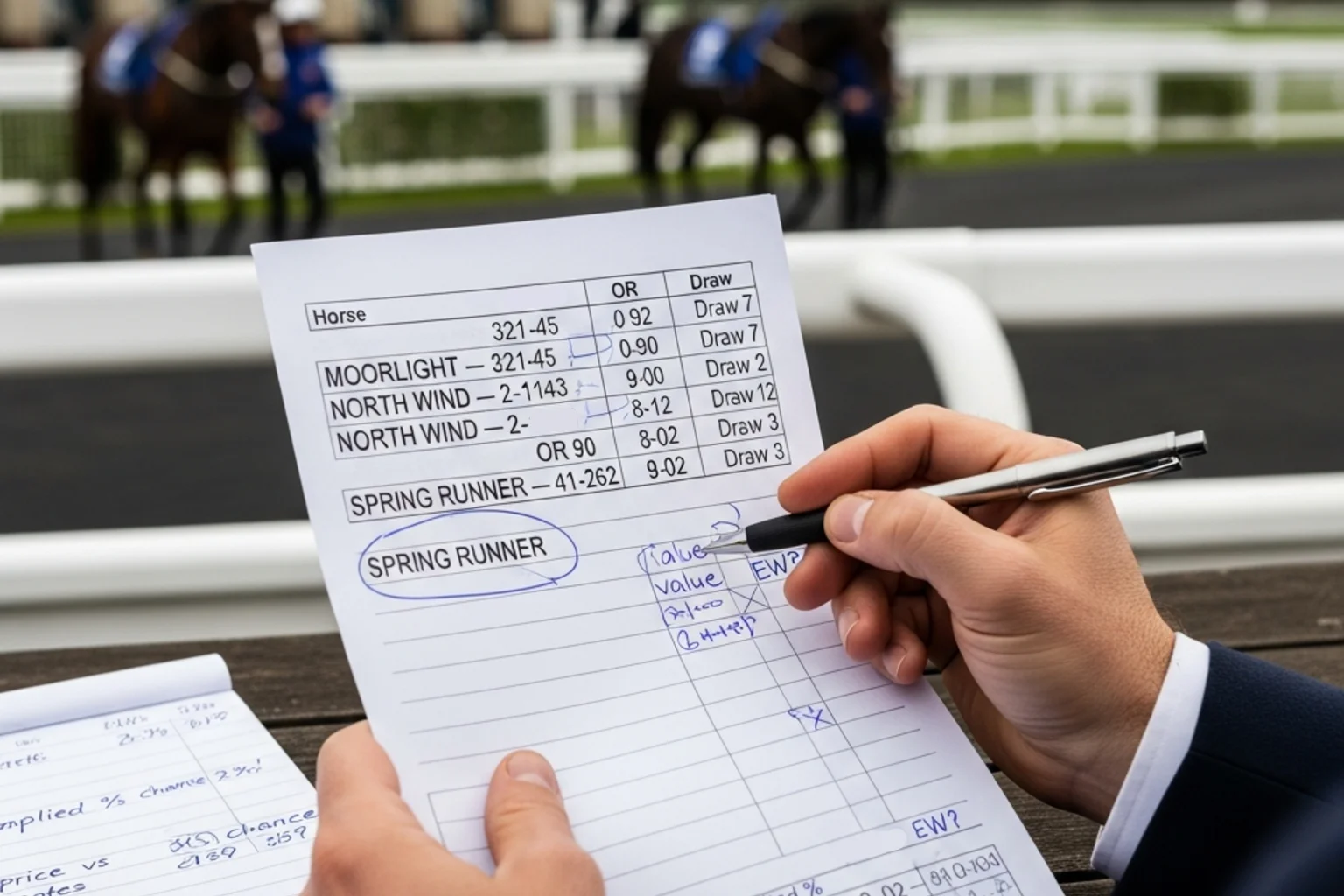
Value betting represents the single most important concept separating successful punters from recreational losers. The principle is straightforward: back horses at prices higher than their true probability of winning warrants. A horse with a genuine 20% chance of victory represents value at 6/1 (implied probability 14.3%) but not at 3/1 (implied probability 25%). The challenge lies entirely in assessing true probabilities—something bookmakers do professionally and punters attempt with varying success.
The Lincoln Handicap creates unusual value-finding opportunities. Large fields dilute bookmaker expertise across many runners. Competitive handicapping compresses genuine chances into narrow probability bands. Early-season uncertainty about form and fitness introduces variables that statistical models struggle to capture. These conditions collectively create overlays—situations where the available price exceeds fair odds for a horse’s realistic chances.
Historical results support this proposition. Seven of the last eleven Lincoln winners started at 12/1 or longer. Market favourites have won just once in the same period. Either bookmakers systematically misprice this race, or the public systematically overestimates shorter-priced runners. Probably both. Understanding how to exploit these patterns requires grasping value betting mechanics and applying them specifically to Lincoln conditions.
What Is Value Betting?
Value exists when the odds offered exceed the true probability of an outcome. If a horse genuinely has a 25% chance of winning, any price above 3/1 represents value. A 20% chance means anything above 4/1. The mathematical relationship is inverse: divide 100 by the implied probability percentage to find the fair decimal odds (then convert to fractional if preferred). A horse with a 10% genuine chance requires odds of 10.0 decimal, or 9/1 fractional, to represent fair value.
Bookmakers build margins into every price they offer. A hypothetical two-horse race where both runners have exactly 50% chances would see a fair book at 1/1 each—evens across the board. Instead, bookmakers typically offer something like 10/11 each, paying less than fair value on either outcome. The difference between theoretical payouts (100%) and actual payouts (in this case about 91%) constitutes the bookmaker’s edge.
This margin, called the over-round, varies significantly across different races and bookmakers. Lincoln Handicap markets historically show over-rounds ranging from 117% to 140%, with the 2025 renewal hitting the highest margin in two decades. Higher over-rounds mean less value available in aggregate—but distribution matters. A 130% book might still contain genuine overlays on specific runners if the margin concentrates elsewhere in the market.
Value betting does not guarantee short-term profits. A horse representing value at 8/1 will still lose more often than it wins. The edge manifests over many bets, not individual selections. Professional punters accept frequent losses while maintaining statistical advantages. Recreational punters often chase winners rather than value, backing favourites that offer poor expected returns while avoiding longshots that offer positive expectation.
Identifying Overlays
An overlay occurs when a horse’s market price implies a lower probability than its true chances warrant. Identifying overlays requires two competencies: accurately assessing true probabilities and comparing those assessments against market prices. Neither is simple. True probabilities remain inherently unknowable; you can only estimate them based on available evidence. Market prices themselves aggregate the estimates of many participants, including bookmakers with substantial analytical resources.
Form analysis provides the foundation for probability estimation. A horse that has finished in the first three in five of its last six starts clearly demonstrates consistent competitiveness. One that has not finished closer than fifth in a year presents obvious concerns. Beyond raw results, examine the contexts: who did they beat, what conditions did they face, how do those conditions compare to today’s race? The Lincoln occurs early in the season, meaning recent form from the previous autumn requires adjustment for winter improvement or deterioration.
Speed figures and ratings offer quantitative approaches. Timeform, Racing Post Ratings, and similar metrics assign numerical values to performances, allowing direct comparison across horses. A horse rated 102 performed, at some point, at a level theoretically equivalent to others rated 102. These figures simplify complex assessments but obscure important details—a horse rated 102 on heavy ground differs meaningfully from one rated 102 on good to firm.
Market comparison across bookmakers reveals price discrepancies that sometimes indicate overlays. If one bookmaker offers 14/1 while others cluster at 10/1, either the outlier has made an error or possesses information others lack. Odds comparison sites highlight these discrepancies instantly. Backing the best available price on any selection compounds marginal advantages over time.
Lincoln-Specific Value Angles
The Lincoln’s status as a season opener creates systematic mispricings. Horses that winter well often return improved, but markets typically underweight this potential. A horse that showed progressive form through autumn, then reappears fresh in spring, may have continued developing—yet markets often anchor to last-seen form without adjusting for likely improvement. Trainers known for targeting this specific race with well-prepared horses systematically outperform market expectations.
Large fields dilute public attention toward obvious contenders, leaving longer-priced runners under-analysed. When twenty runners line up, casual punters focus on the market leaders while ignoring perfectly capable alternatives. The favourite attracts disproportionate money regardless of actual chances, suppressing its odds while inflating those of lesser-fancied runners. This attention asymmetry creates value further down the market—exactly where Lincoln winners tend to emerge.
Draw advantages add another value dimension. Historical data shows clear bias toward higher-numbered stalls in the Lincoln, yet markets often fail to fully price this advantage. A horse drawn low might warrant odds closer to 25/1 than the 16/1 offered, while one drawn high represents relative value even at shorter prices. Combining draw analysis with form assessment identifies runners where multiple factors align favourably but market prices have not fully adjusted.
Trainer intent provides qualitative overlay signals. Some yards target the Lincoln specifically as a prestigious season opener. Others enter horses speculatively without genuine commitment. Learning which trainers historically perform well in the race—and which merely use entries to keep options open—helps distinguish genuine contenders from market noise. William Haggas has won this race five times precisely because he prepares specifically for it. His runners typically represent fair value even at shorter prices; runners from yards with no Lincoln pedigree may be underlays despite longer odds.
Value vs Price
A common beginner mistake conflates value with price. Long odds do not inherently represent value; short odds do not inherently represent poor value. A 100/1 shot with a genuine 0.5% chance represents terrible value—you need odds of 200/1 to break even. A 6/4 favourite with a genuine 50% chance represents excellent value, offering higher returns than fair probability would warrant. Value exists at all price points; price alone tells you nothing about value.
The Lincoln specifically attracts outsider value because markets overbet favourites. Over twenty-five years, favourites have won just seven times—a 28% strike rate. That figure sounds reasonable until you calculate implied returns. Backing every favourite at average starting prices would have produced losses despite regular winners. Meanwhile, filtering for specific characteristics among outsiders—age, weight, draw position—produces positive expected value even accounting for many losers.
Value betting requires emotional discipline that recreational approaches do not. Backing a 16/1 shot that you believe represents value means accepting that it will likely lose. Then backing another. Then another. The variance across a season of Lincoln-type bets can feel brutal—long losing runs punctuated by occasional substantial wins. Professional punters bank these wins against anticipated losses. Recreational punters often abandon value strategies after a few losers, reverting to favourite-backing just before the value approach would have paid off.
Staking connects value assessment to practical betting. Larger stakes on higher-value selections maximise expected returns. Level stakes on all selections ignore value gradations. Sophisticated approaches weight stakes according to perceived edge—betting more when value is substantial, less when marginal. The Lincoln offers enough variables that different runners represent different value levels; adjusting stakes accordingly improves overall expectation.
Value betting transforms the Lincoln from a lottery into a strategic exercise. The race’s characteristics—large fields, seasonal timing, draw biases, and market inefficiencies—create conditions where careful analysis can identify genuine overlays. Finding value does not guarantee winning any single bet, but it shifts long-term expectation in your favour. That shift, compounded across many races and seasons, separates punters who grind profits from those who entertain bookmakers. The Lincoln, more than most heritage handicaps, rewards those who look beyond price toward genuine probability assessment.
