
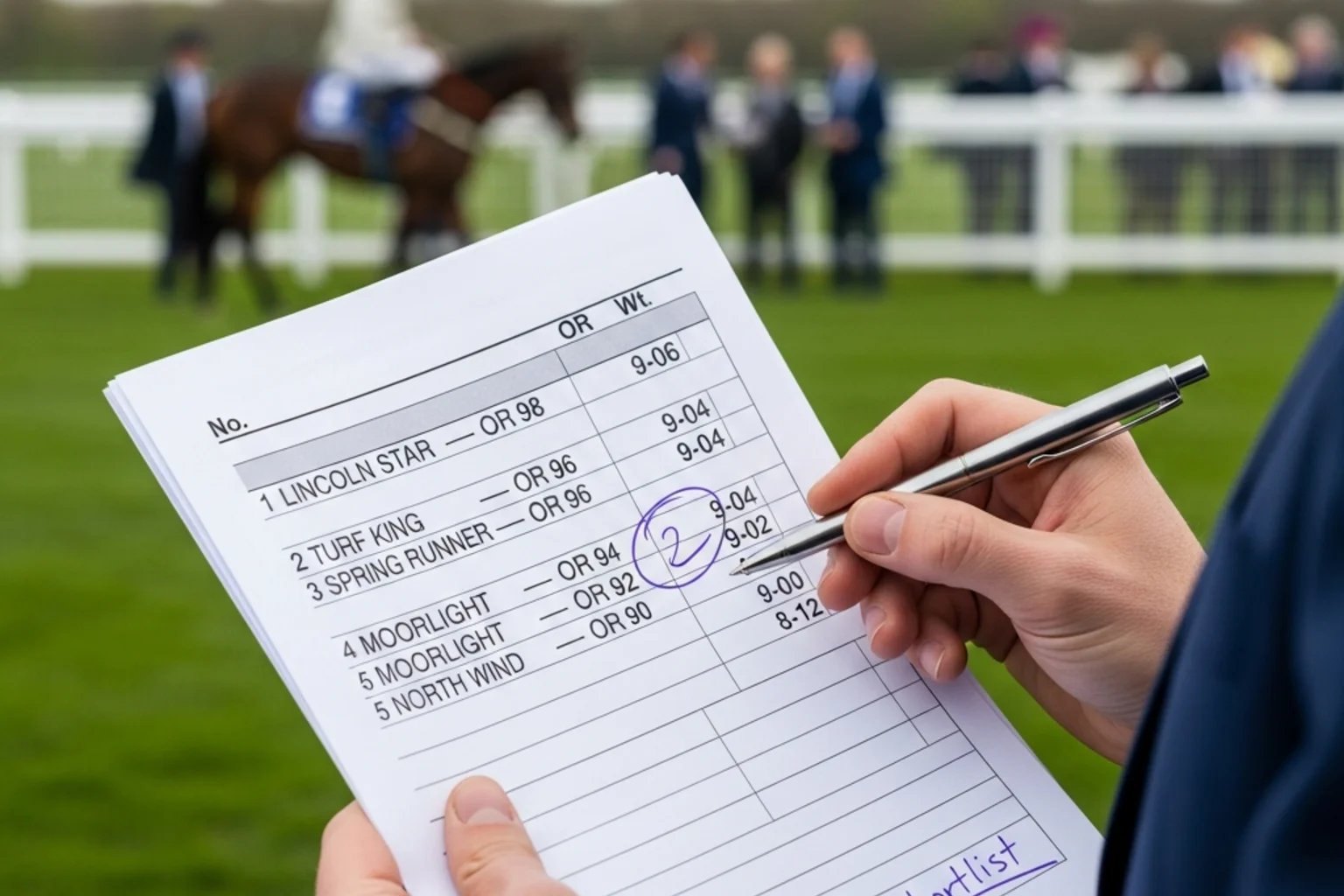
Official ratings form the backbone of handicap racing. Every horse in training receives a numerical assessment of its ability, and that number determines how much weight it carries in handicap races. The Lincoln Handicap, as one of the most competitive handicaps on the calendar, showcases how ratings translate into real-world racing outcomes.
Analysis of Lincoln results reveals a pattern that punters can exploit. Winners since 2014 have clustered within a narrow rating band, specifically between 94 and 102. Eight of the last ten winners held ratings in this range, suggesting the race favours horses of a particular ability level rather than the highest-rated or lowest-rated entries.
Understanding what official ratings mean, how they translate into weight, and why the 94-102 range produces Lincoln winners provides a data-driven framework for selection. This guide explains the rating system and its practical application to identifying likely Lincoln contenders.
What Is an Official Rating?
The British Horseracing Authority employs official handicappers who assess every horse’s ability after each run. These assessments produce official ratings, expressed as numbers that allow direct comparison between horses. A horse rated 100 is considered ten pounds better than a horse rated 90, meaning they should finish level if the higher-rated horse carries ten pounds more.
Ratings are not fixed. They adjust after each performance as handicappers incorporate new information. A horse that wins impressively may be raised several pounds. One that runs poorly might be lowered. This constant recalibration aims to keep ratings accurate, though the system contains inherent lag as assessments follow rather than predict changes in form.
New horses receive initial ratings after two or three runs, once handicappers have sufficient evidence to make an assessment. These early ratings are necessarily speculative, which creates opportunities when young horses prove better or worse than their initial marks suggest. The Lincoln, coming after winter breaks, amplifies uncertainty about whether ratings reflect current ability.
The rating scale theoretically has no upper limit, but in practice, the best flat horses rate between 115 and 130, while average handicappers fall between 70 and 95. Lincoln entries typically rate from the mid-80s to around 105, representing the better class of handicapper without reaching Group race territory.
Handicappers work for the BHA rather than bookmakers, maintaining independence from commercial betting interests. Their goal is competitive racing rather than unpredictable results. A well-handicapped field, where ratings accurately reflect ability, produces close finishes. The Lincoln’s reputation for competitive racing suggests the handicapping system works reasonably well for this race.
The 94–102 Pattern
The statistics demand attention. According to race analysis, eight of the last ten Lincoln winners since 2014 held official ratings between 99 and 102, an even tighter band within the broader 94-102 range. This concentration suggests the Lincoln rewards horses of a specific class level with remarkable consistency.
Why does this narrow range produce so many winners? Horses rated 99-102 possess genuine ability without being the highest-rated horses in the field. They carry reasonable weights rather than the burdensome top weights that handicap horses rated 105 or above. This combination of quality and manageable weight creates favourable conditions for success.
Lower-rated horses, those below 94, typically lack the class to win a race of the Lincoln’s calibre. Their weight allowances do not fully compensate for the ability gap against horses ten or fifteen pounds better. When the race is run at a true gallop, quality tells, and lower-rated horses cannot sustain the effort required to beat their betters.
Higher-rated horses face the opposite problem. A horse rated 106 concedes weight to the entire field, effectively giving every opponent a head start. The weight spread in a Lincoln typically spans over a stone, meaning the top weight gives significant amounts to every rival. Unless it possesses exceptional class, the burden proves too great.
The 94-102 band identifies horses with the best combination of ability and weight. They are good enough to win competitive handicaps, as their ratings demonstrate, but not so highly rated that they carry crippling burdens. Filtering the Lincoln field to this rating range eliminates roughly half the runners while retaining the horses statistically most likely to win.
This pattern correlates with the weight findings: nine of the last eleven winners carried between 8st 12lbs and 9st 4lbs. The rating band and weight range are two ways of expressing the same underlying principle. Horses at a particular ability level, carrying weights that reflect that ability without overburden, dominate Lincoln results.
Ratings vs Weight Carried
The relationship between rating and weight carried is straightforward in principle. The highest-rated horse in the field carries top weight, typically around 10st 0lbs in the Lincoln. Each pound of rating difference translates to a pound of weight difference. A horse rated ten pounds below the top weight carries 9st 4lbs, and so on.
Penalties and allowances modify this baseline. Horses who have won recently may carry additional weight above their rating. Those ridden by apprentice jockeys claiming allowances carry less. These adjustments mean the actual weight carried can differ from what the raw rating implies, creating occasional value when the market does not fully account for these differences.
The Lincoln’s weight range typically spans from around 10st 0lbs for the top weight down to 8st 2lbs for the lowest-rated qualifiers. Within this spread, the 8st 12lbs to 9st 4lbs range that produces most winners corresponds to ratings in the high 90s to low 100s. The correlation is not coincidental; it reflects the same underlying dynamic viewed from different angles.
Jockey claims deserve consideration when assessing effective weights. A five-pound claimer riding a horse rated 100 creates an effective rating advantage, as the horse carries less than its rating implies. These claims are particularly valuable in handicaps where weight differences matter. The Lincoln, with its large field and tight finishes, amplifies any weight advantage.
The handicapper’s challenge lies in accurately assessing improving horses. A horse rated 95 might have improved to 100 ability over the winter. If that improvement has not been reflected in a rating rise, the horse runs from an advantageous mark. Identifying such horses before the market does offers betting value.
Using Ratings in Selection
The 94-102 rating filter provides a starting point for Lincoln selection. Eliminating horses outside this range removes roughly half the field from serious consideration, leaving a more manageable number for detailed analysis. This approach sacrifices the occasional outlier winner but improves the chances of identifying the actual winner from the remaining pool.
Within the target rating band, other factors determine which horse to back. Form trajectory matters more than static rating. A horse whose rating has risen from 90 to 98 over recent starts demonstrates improvement that might continue. One whose rating has dropped from 104 to 99 might be regressing, with its current mark overstating its current ability.
Compare each horse’s rating to its career peak. A horse rated 99 whose peak was 100 has limited scope for improvement. One rated 99 whose peak was 95 has demonstrated progressive form and might continue rising. These distinctions help identify horses likely to outperform their ratings on Lincoln day.
Cross-reference rating analysis with other filters. A horse rated 100, aged four, carrying 9st 2lbs, and drawn well combines multiple positive indicators. Finding horses that satisfy several criteria simultaneously increases confidence that the selection aligns with historical winning patterns.
Recognise that ratings measure past performance, not future results. The Lincoln rewards horses who have improved beyond their ratings, whose true ability exceeds the handicapper’s assessment. Identifying such horses requires judgement that goes beyond mechanical filtering, but the filtering process narrows the search to horses in the right zone.
Official ratings provide an objective basis for Lincoln selection that avoids the subjectivity of pure form analysis. The 94-102 pattern offers a data-driven filter that has produced eight of the last ten winners. Using ratings systematically, in combination with other trend filters, helps identify horses whose profiles match those of recent Lincoln winners.