

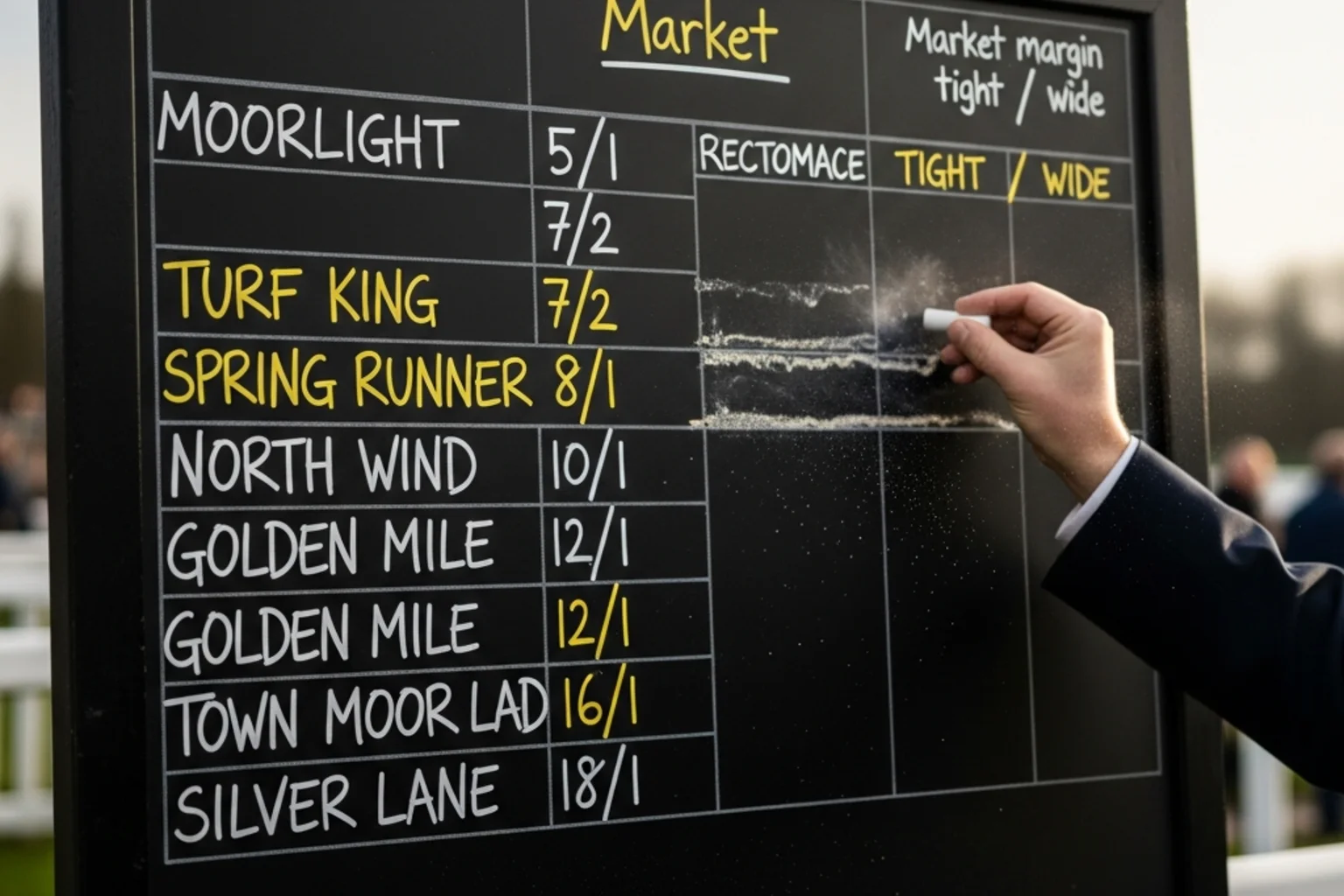
Every betting market contains a built-in house edge called the over-round. This margin determines how much bookmakers retain from total wagers regardless of the outcome. Understanding over-round transforms your perception of odds from face-value prices to evaluations that include hidden costs. In large-field handicaps like the Lincoln, over-round calculations become particularly relevant—and revealing about where genuine value might exist.
The Lincoln Handicap demonstrates remarkable variation in bookmaker margins across years. Historical data shows over-rounds ranging from 117% to 140% over the past two decades, with the 2025 renewal hitting the maximum. This 23-percentage-point spread represents enormous differences in punter value. A market at 117% over-round returns significantly more to bettors than one at 140%. Yet most casual punters place bets without calculating—or even considering—these margins.
This guide explains how over-round works, examines historical patterns in Lincoln betting markets, demonstrates what different margin levels mean for your returns, and identifies strategies for finding better value despite bookmaker edges. The mathematics is straightforward; applying it consistently separates informed bettors from those who simply accept whatever prices bookmakers offer.
What Is Over-Round?
Over-round measures the total implied probability across all runners in a race. In a theoretically fair market, these probabilities would sum to exactly 100%. A horse at 4/1 implies 20% chance; one at 9/1 implies 10%. Add up all runners and you should reach 100% if the market were perfectly efficient. Bookmakers ensure the total exceeds 100%, creating their profit margin—the over-round, also called the vig, juice, or margin depending on your gambling dialect.
To calculate over-round, convert each fractional price to implied probability, then sum. A horse at 3/1 has implied probability of 25% (calculated as 1 divided by 4). At 7/1, that becomes 12.5% (1 divided by 8). For decimal odds, divide 100 by the decimal price. Continue for every runner, then total. If the sum equals 120%, the over-round is 120%—or expressed as margin, 20% above fair.
This excess directly affects your expected returns. At 100% over-round (impossible in practice), backing every horse in proportion to its odds would return exactly your stake. At 120%, that same approach returns only about 83% of your stake. At 140%, roughly 71%. The higher the over-round, the more bookmakers extract before any winner is paid. Even backing actual winners returns less than true odds would warrant because every price has been trimmed to build that margin.
Field size influences over-round substantially. Two-horse races typically run tight margins—bookmakers compete fiercely when choices are limited. Twenty-horse handicaps allow more generous margins because punters distribute attention across many options. Bookmakers can shade prices across the field without any single runner appearing obviously poor value. The Lincoln’s large fields create natural conditions for higher over-rounds.
Lincoln Over-Round History
Lincoln Handicap betting markets have grown progressively less competitive over the past decade. The most punter-friendly market occurred in 2014, with an over-round of just 117%—unusually tight for a big-field handicap. This figure suggests intense bookmaker competition that year, possibly driven by promotional pricing around the flat season opener. Backing runners across that market cost bettors relatively little in margin.
Subsequent years showed gradual margin expansion. By the early 2020s, Lincoln over-rounds routinely exceeded 125%. The 2025 renewal reached 140%—the highest recorded across two decades of data. This figure represents a market where bookmakers collectively retain nearly 40% more than a fair book would justify. Punters face substantially worse value at these levels, regardless of which horse they back.
Several factors explain this trend. Declining betting turnover on British racing—down 19% since 2021/22—pressures bookmaker margins across all markets. Reduced competition among operators allows surviving bookmakers to widen margins without losing market share. The shift toward exchange betting for serious punters leaves traditional bookmaker markets serving more casual customers less sensitive to value comparisons.
Year-to-year variation remains significant, however. Specific competitive dynamics—new bookmaker promotions, exchange activity levels, or simply the composition of the field—influence annual over-rounds. Checking each year’s actual margins rather than assuming consistency helps identify when conditions favour punters and when they favour the house.
117% vs 140%: What It Means
The practical difference between 117% and 140% over-round substantially impacts punter returns. Consider a £100 stake distributed proportionally across all runners to guarantee backing the winner. At 117% over-round, you collect approximately £85.50—losing £14.50 to the margin. At 140%, that return drops to roughly £71.50—losing £28.50. The 23-point spread costs an additional £14 per £100 wagered, doubling your effective losses.
For single-selection bettors, the impact appears through compressed prices. A horse that would be 10/1 in a 100% book becomes roughly 8/1 at 117% margin and about 6/1 at 140%. Every price shrinks proportionally to accommodate the bookmaker’s edge. Winning at 6/1 instead of 10/1 reduces returns by 40%—a significant difference that compounds across multiple bets over a betting career.
As Alan Delmonte, Chief Executive of the Horserace Betting Levy Board, observed: “Levy yield for the 12 months to 31 March 2025 reached almost £109m, the fourth successive year of increase. With Levy income having risen for a fourth consecutive period, it may seem counterintuitive that the Board continues to express caution about the sustainability of this trend. This wariness derives from an ongoing fall in betting turnover on British horseracing.” Part of this pattern reflects exactly these margin dynamics—bookmakers extract more per pound wagered even as total pounds wagered decline. Punters paying higher margins generate similar revenue to larger punter pools at lower margins. The individual bettor bears increased costs while industry economics remain stable.
Each-way betting amplifies over-round effects. Place markets typically carry higher margins than win markets because bookmakers face greater complexity in pricing multiple payout positions. An each-way bet in a 140% over-round market might face effective margins of 145-150% on the place portion. The combined impact reduces expected returns below what the advertised win odds suggest.
Finding Better Value
Betting exchanges offer the most direct route to reduced margins. Exchanges like Betfair and Sportsbet.io match bettors against each other rather than against a bookmaker, charging commission on winning bets instead of building margins into prices. Lincoln exchange markets frequently run below 105% over-round—dramatically better than traditional bookmaker offerings. The trade-off involves potentially reduced liquidity and the need to manage exchange-specific mechanics.
Odds comparison sites identify the best traditional bookmaker prices instantly. When one bookmaker offers 14/1 while competitors cluster at 10/1, capturing that outlier price reduces your personal over-round exposure. Serious punters maintain accounts with multiple bookmakers specifically to access best available prices consistently. The administrative overhead repays itself through improved returns over time.
Timing matters for margin management. Early-morning prices often carry lower over-rounds than those available near race time, as bookmakers initially post competitive odds to attract business before adjusting based on market flows. Ante-post markets, despite their non-runner risks, sometimes offer better effective margins than race-day betting. Monitoring how markets evolve through the betting day reveals when conditions favour punters.
Promotional offers partially offset high margins. Best Odds Guaranteed, enhanced each-way terms, and money-back specials reduce effective over-round by providing potential upside without additional cost. A BOG offer that pays starting price when it exceeds your bet price effectively improves your odds at no charge. Stacking multiple promotional advantages can narrow the gap between actual margins and punter-friendly levels.
Over-round represents the invisible tax on every bet you place. Understanding it demystifies bookmaker pricing and reveals why identical selections at different bookmakers produce different expected returns. The Lincoln’s historical margin variation—from competitive 117% to punitive 140%—demonstrates how much value fluctuates year to year and market to market. Checking margins, seeking best prices, and exploiting promotional offers collectively reduce the house edge you face. These habits require minimal effort but generate meaningful improvements to long-term betting returns.
