

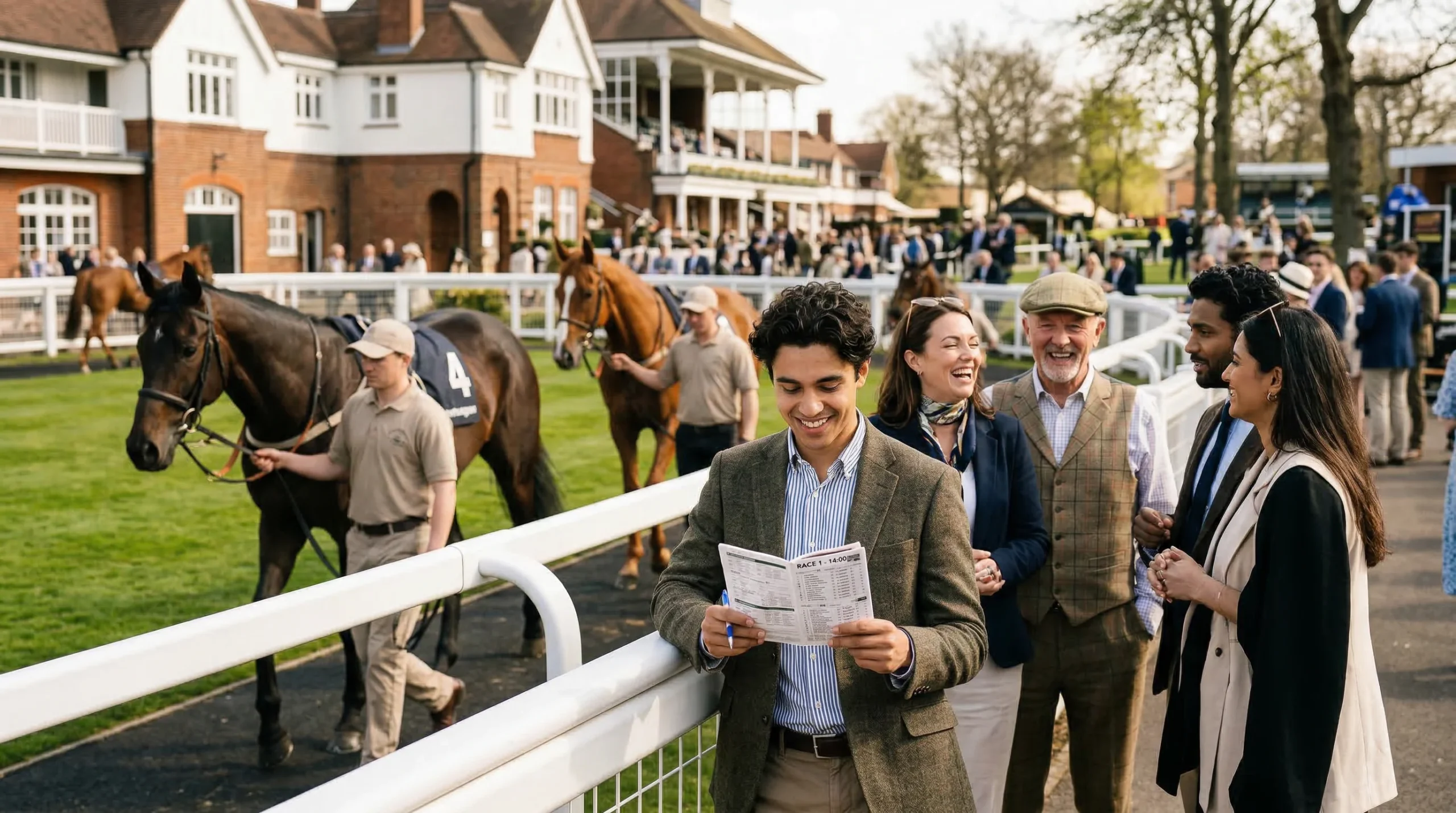
Horse racing in Britain is not simply a sport—it is a cultural institution that generates £4.1 billion annually for the UK economy. The sport attracts millions of spectators to racecourses each year, but its betting ecosystem draws in far more participants who never set foot on a track. If you are looking to place your first wager on a British horse race, understanding the fundamentals is essential before you risk real money.
This guide covers the core knowledge every beginner needs. We will examine how odds work across different formats, break down the main bet types from simple win bets to each-way wagers, explain how to read basic form, and outline what to look for when selecting a bookmaker. None of this requires prior knowledge of racing. By the end, you should feel confident enough to place an informed bet—or at least understand why the person next to you at the pub is convinced their 20/1 outsider is a certainty.
The UK betting market operates differently from other countries. British bookmakers compete vigorously for customers, which creates advantages for punters who know where to look. Online betting turnover on British racing reaches £5.4 billion annually, reflecting a market where digital platforms have become the primary way people engage with the sport. Whether you intend to bet at the track, in a betting shop, or from your phone, the principles remain identical.
Understanding Odds Formats
British bookmakers predominantly use fractional odds, the traditional format you will encounter at racecourses and in betting shops. A horse priced at 5/1 (spoken as “five to one”) means you win £5 for every £1 staked, plus your original stake back. So a £10 bet at 5/1 returns £60 in total: £50 in winnings plus your £10 stake. The first number represents potential profit, the second your stake requirement.
Fractional odds below evens indicate short-priced favourites. A horse at 1/2 (“one to two” or “evens on”) requires you to stake £2 to win £1. These prices reflect horses the market considers highly likely to win. Conversely, longer odds like 33/1 represent rank outsiders—rewarding substantially but winning infrequently. Understanding this relationship between price and probability is fundamental to all betting decisions.
Decimal odds, common on European betting exchanges and increasingly on UK sites, work differently. The number represents your total return for a £1 stake, including the stake itself. Decimal 6.00 equals fractional 5/1. Decimal 1.50 equals fractional 1/2. Many punters find decimals easier for calculating exact returns, particularly when dealing with unusual fractional prices like 11/8 or 100/30. Most online bookmakers allow you to toggle between formats in your account settings.
The relationship between odds and implied probability matters more than most beginners realise. A horse at 4/1 has an implied probability of winning of 20% (calculated as 1 divided by 5, where 5 is the sum of both numbers plus 1). However, bookmakers build profit margins into their odds, meaning the true implied probabilities across all runners in a race sum to more than 100%. This excess is called the over-round, and competitive markets typically run between 115% and 130%. More on this later when we discuss bookmaker selection.
Types of Bets
The simplest wager is a win bet: you back a horse to finish first, and if it does, you collect at the advertised odds. If your selection finishes second, third, or anywhere else, you lose your stake entirely. Win betting suits punters who have strong opinions about specific horses and want maximum returns on those convictions. There is no complexity here—your horse wins or it does not.
Each-way betting offers insurance for competitive fields. An each-way bet is actually two separate bets: one for your horse to win, and one for it to place (typically finishing in the top two, three, or four depending on field size and race type). The place portion pays at a fraction of the win odds, usually 1/4 or 1/5. A £10 each-way bet at 10/1 with 1/4 place terms costs £20 total (£10 win, £10 place). If your horse wins, you collect on both portions. If it places without winning, you lose the win stake but collect on the place part at 10/4 (2.5/1), returning £35 on that £10 place bet.
Each-way betting makes mathematical sense at longer odds in larger fields. In handicaps like the Lincoln, where twenty or more runners are common and multiple place positions are paid, backing a 16/1 shot each-way provides reasonable returns even for placed finishes. At shorter prices in smaller fields, the place portion offers limited value—a horse at 3/1 with 1/5 place terms only returns 3/5 of your stake for placing, barely worth the effort.
Multiple bets combine selections across different races. A double requires both selections to win, with returns from the first bet rolling onto the second. A treble extends this to three selections. Accumulators (four or more legs) offer eye-catching potential returns but increasingly improbable outcomes. The appeal is obvious—a £1 accumulator backing five 10/1 shots returns over £161,000 if all win. The reality is that bookmakers love accumulators because the compounding probability of multiple events makes payouts rare. For beginners, singles and each-way bets offer clearer value propositions.
Ante-post betting involves placing wagers days, weeks, or months before a race. Odds are typically longer because you assume the risk of non-runners—if your selection does not run, you lose your stake (unless stated otherwise). Big handicaps attract substantial ante-post markets, and early prices occasionally offer genuine value before the market corrects. However, ante-post betting requires accepting uncertainty about ground conditions, final declarations, and potential injuries. It suits punters with strong opinions formed early, not those who prefer to assess conditions on race day.
Reading Form Basics
Form figures appear beside every horse’s name and represent recent finishing positions, read left to right from oldest to most recent. A horse showing 312-41 finished third, then first, then second, then (after a seasonal break indicated by the hyphen) fourth and most recently first. These numbers tell you whether a horse is currently competitive and whether it has winning form at all.
Certain symbols modify or replace numbers. A zero indicates a finish outside the first nine. The letter P means the horse pulled up and did not complete the race. F represents a fall (primarily in jump racing). U indicates the horse unseated its rider. C means the horse was carried out by another falling horse. These details matter—a horse with recent zeros might be out of form, while a horse showing PF-123 clearly overcame earlier problems to find winning ways.
Course and distance form receives particular attention from experienced punters. A small ‘C’ next to form figures often indicates the horse has won at today’s course, while ‘D’ indicates a winner at today’s distance. Some horses perform consistently better at specific tracks—whether due to track configuration, going preferences, or simply quirks of temperament. A horse winning at Doncaster’s straight mile previously merits closer attention than one whose victories came on turning tracks.
Handicap ratings and official ratings (OR) quantify ability numerically. The British Horseracing Authority assigns ratings from roughly 0 to 140, with higher numbers indicating better horses. In handicaps, these ratings determine weight carried—better-rated horses carry more to theoretically equalise chances. A horse rated 95 carrying 9st 0lbs faces a different challenge than one rated 85 carrying 8st 4lbs. Understanding relative ratings helps assess whether any horse holds a notable advantage.
Choosing a Bookmaker
All licensed UK bookmakers operate under Gambling Commission regulations, ensuring basic standards around fair odds, prompt payouts, and responsible gambling measures. Beyond these fundamentals, bookmakers differ substantially in their pricing, promotions, and specific strengths. Shopping around for the best odds on your selected horse can increase returns by 10-20% over a season of betting.
Best Odds Guaranteed (BOG) is a key feature for racing bettors. Bookmakers offering BOG pay you at the starting price if it exceeds your original bet price. You place a bet at 8/1 in the morning, the horse drifts to 12/1 by race time, and you collect at 12/1 if it wins. Most major bookmakers offer BOG on UK and Irish racing, though terms vary—some exclude ante-post bets, others limit maximum payouts. Always verify a bookmaker’s BOG policy before assuming it applies.
Odds comparison tools, available on numerous independent websites, let you instantly identify which bookmaker offers the best price on any selection. Price differences of a point or two might seem trivial, but betting 10/1 instead of 9/1 represents a 10% increase in potential profit. Over hundreds of bets, these marginal gains compound significantly. Serious punters typically hold accounts with multiple bookmakers specifically to access optimal pricing.
As Anne Lambert CMG, Interim Chair of the Horserace Betting Levy Board, noted in the 2024-25 annual report: “Racing is facing significant challenges so I am delighted to report that in 2024/25 the Board’s expenditure supporting Racing was £94.3m, a 4% increase on the previous year.” Your bets contribute to prize money and racecourse operations through the levy system. Understanding this ecosystem does not change your betting strategy, but it contextualises why bookmakers compete so vigorously for racing customers—the market remains substantial despite shifts toward other sports and in-play betting formats.
Betting on horse racing combines skill, research, and inevitably some luck. The fundamentals covered here—understanding odds, selecting appropriate bet types, reading basic form, and choosing bookmakers wisely—provide a foundation for informed wagering. Start with small stakes while you learn. The Lincoln Handicap and similar heritage races offer excellent opportunities to apply these principles, though the same approach works across all British racing. Knowledge compounds just as surely as losses can—invest in understanding the sport before you invest your bankroll.
